

Have you ever wanted to create stunning, realistic drawings of your kitchen? Imagine impressing friends and family with artwork that captures the heart of your home with accuracy and flair.
Drawing a kitchen in two-point perspective can transform your sketches into captivating, lifelike scenes. It’s a skill that can elevate your artistic projects, whether you're decorating your space, planning a remodel, or simply enjoying a creative hobby. In this guide, you'll discover how to master the essentials of two-point perspective to bring your kitchen drawings to life.
By the end, you’ll not only have a new skill but also a fresh way to express your creativity. Ready to dive in and unleash your inner artist? Let's get started!
Basics Of Two Point Perspective
Two point perspective helps you draw objects in a realistic way. It shows how things get smaller as they move away. This method is great for drawing rooms and buildings.
In two point perspective, you use two vanishing points on the horizon line. These points guide how lines go to show depth and space.
Vanishing Points And Horizon Line
The horizon line is where the sky meets the ground in your drawing. It represents the viewer's eye level. Vanishing points sit on this line and help create depth.
- Place two vanishing points far apart on the horizon line.
- All horizontal lines of the object go to one of these points.
- Vertical lines stay straight and do not go to vanishing points.
- The horizon line shows where your eyes are in the scene.
Setting Up The Perspective Grid
Start by drawing a straight horizon line across your paper. Mark two vanishing points on this line. These points guide the perspective grid.
| Step | Action | Purpose |
| 1 | Draw horizon line | Set eye level |
| 2 | Mark two vanishing points | Guide object edges |
| 3 | Draw lines from points | Create grid for depth |
| 4 | Add vertical lines | Keep object upright |

Credit: www.youtube.com
Sketching The Kitchen Layout
Drawing a kitchen in two point perspective helps create a realistic look. It shows depth and space clearly.
Start by planning the main parts of the kitchen. This makes your drawing balanced and easy to follow.
Drawing The Walls And Floor
Begin by drawing two vanishing points on your paper’s horizon line. These will guide the walls and floor.
Draw lines from each vanishing point. These lines form the edges of the walls and floor.
- Sketch vertical lines for corners between walls.
- Use the vanishing points to draw horizontal lines for walls and floor edges.
- Check that all lines meet at the right vanishing point for accuracy.
Placing Major Appliances
After the walls and floor, add big appliances like the fridge and stove. Place them along the walls.
Use the same vanishing points to keep appliances in correct perspective.
- Draw boxes to show the size and position of each appliance.
- Make sure edges align with the wall lines going to vanishing points.
- Keep space between appliances for a natural layout.
Adding Cabinets And Countertops
Drawing cabinets and countertops in two point perspective adds depth to your kitchen sketch. It helps show the space clearly and makes your drawing look real.
Start with the main shapes and add details step by step. Focus on lines that guide the perspective and keep cabinets aligned.
Drawing Upper Cabinets
Upper cabinets sit above the countertop and follow the same perspective lines. Begin by drawing the top edges toward each vanishing point.
- Draw vertical lines for the cabinet sides.
- Use the horizon line to align the cabinet height.
- Add details like doors and handles inside the cabinet shape.
- Keep spacing even to create a uniform look.
Designing Lower Cabinets And Counters
Lower cabinets support the countertop and are drawn below the horizon line. Use perspective lines to set their depth and width.
| Part | Drawing Tip |
| Cabinet Base | Draw vertical edges from floor to counter height |
| Countertop | Extend lines from cabinet tops to vanishing points |
| Drawers and Doors | Use horizontal and vertical lines inside cabinet shapes |
| Handles | Add small shapes centered on doors or drawers |
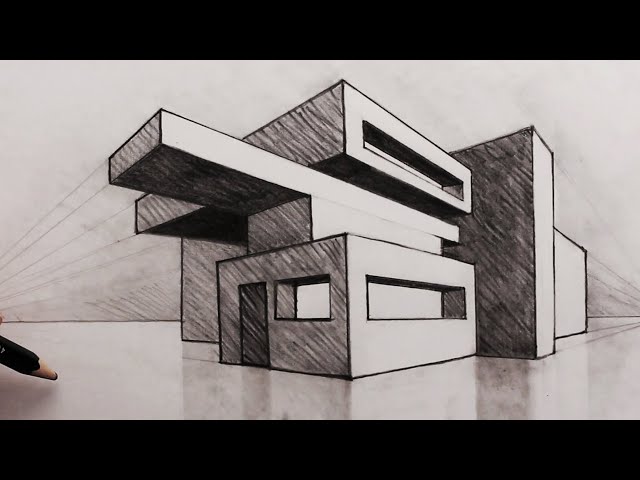
Credit: www.youtube.com
Detailing Fixtures And Accessories
Adding fixtures and accessories makes your kitchen drawing look real. These small details bring life to the space.
Focus on shapes and sizes to keep perspective correct. This helps your drawing feel three-dimensional and complete.
Sketching The Sink And Faucet
Draw the sink as a rectangle or square on the countertop. Use light lines to mark its edges in two-point perspective.
The faucet usually sits behind the sink. Draw a small curved shape for the spout and two knobs or handles on the sides.
- Use vanishing points to keep the sink edges aligned.
- Keep the faucet simple with curved and straight lines.
- Add small details like the drain or spray hose if space allows.
Adding Lighting And Small Items
Add light fixtures such as ceiling lamps or under-cabinet lights. Show their shapes with simple geometric forms.
Place small kitchen items like fruit bowls, mugs, or utensils on counters. Keep their sizes smaller to show distance.
- Use circles and ovals for lights and round objects.
- Draw rectangles or cylinders for jars and containers.
- Keep shadows and highlights simple for a clean look.
Refining Lines And Adding Depth
Drawing a kitchen in two point perspective starts with clean lines. Refining your lines helps define the shapes clearly.
Adding depth makes the kitchen look more realistic and three-dimensional. Use perspective rules to place objects correctly.
Enhancing Shadows And Highlights
Shadows show where light is blocked and create depth. Adding highlights shows where light hits surfaces directly.
Use soft shadows to show distance and sharper shadows for close objects. Highlights can be small bright spots or lines.
- Place shadows opposite the light source
- Use darker tones for deep shadows
- Add highlights on edges facing the light
- Keep shadows softer as they go farther away
Creating Texture And Material Effects
Textures help show what materials the kitchen has, like wood or metal. Use small lines or dots to add texture.
Different materials reflect light differently. Smooth surfaces have clear highlights, rough surfaces scatter light.
- Draw wood grain with short, curved lines
- Use cross-hatching for rough stone or tile
- Add smooth shading for metal or glass
- Vary the texture size for distance and detail
Final Touches And Cleanup
After drawing your kitchen in two-point perspective, it is time to clean up your sketch. This step helps make your drawing clear and ready for the next phase.
Removing extra lines and preparing the drawing will give it a polished look. This makes coloring or shading easier and more effective.
Erasing Guidelines
Start by lightly erasing the construction lines you no longer need. These lines include the perspective guides and extra marks.
Be careful not to erase your main outlines. Keep the important edges clear and visible for the next steps.
- Use a soft eraser for gentle removal
- Hold the paper steady to avoid smudges
- Erase in small areas to control your work
- Keep the main outlines sharp and clean
Preparing For Color Or Shading
Once the lines are clean, check your drawing for missing details. Add any final touches before applying color or shading.
Make sure your paper surface is smooth and free of eraser dust. This helps colors or shading materials stick better and look smooth.
- Lightly press your pencil to avoid deep grooves
- Use a brush or cloth to remove eraser crumbs
- Decide on your light source for shading
- Test colors or shading on a scrap paper first

Credit: www.youtube.com
Frequently Asked Questions
What Is Two Point Perspective In Drawing?
Two point perspective uses two vanishing points on the horizon line. It creates realistic depth and dimension for objects like kitchens. This method helps depict how walls and surfaces recede naturally in space.
How Do You Start Drawing A Kitchen In Two Point Perspective?
Begin by drawing a horizon line with two vanishing points. Sketch the main corner of the kitchen aligned between these points. Then, draw walls, cabinets, and appliances converging toward each vanishing point for accurate proportions.
What Tools Are Needed For Two Point Perspective Drawing?
Essential tools include a ruler, pencil, eraser, and paper. A protractor can help measure angles. Digital drawing software with perspective guides is also useful for precision and corrections.
How Can I Add Kitchen Appliances Accurately In Perspective?
Draw appliances using the same two vanishing points as the walls. Align edges and corners so they recede properly. Use reference images to maintain correct shapes and proportions within the perspective grid.
Conclusion
Drawing a kitchen in two-point perspective helps create depth and space. Start with two vanishing points on your horizon line. Sketch the main shapes and add details step by step. Practice makes your drawings better and more confident. This technique improves your understanding of how objects look in space.
Try different kitchen layouts to explore new ideas. Keep your lines clean and use light strokes first. Soon, your kitchen drawings will look more real and clear. Drawing with two-point perspective is a useful skill for artists and designers.


